Rhythm and Rhyme: No Fear Arabic Poetry
Online | Tuesdays | 6-8pm
12, 19, 26 January 2027 | 2, 9, 16 February 2027
Rhythm and Rhyme is a course designed to give you the keys to unlocking Arabic poetry, and in doing so, develop your Arabic language skills. Developed and taught by poet, translator and teacher Ali Al-Jamri, our pedagogy takes a ‘sound first’ approach, familiarising learners with the sound, cadence and rhythms of Arabic before analysing meaning.
Participants will:
Learn how poetic meters work and, through application, learn three meters
Gain an understanding of four eras of Arabic poetry
Grow familiar with the body of Arabic poetry
Identify ways to use these learnings to further their own independent study of both Arabic language and its poetry.
Poetry has been a defining feature of the language, literature, and identity of Arab people for over 1500 years, but it can often feel inaccessible. An interested learner can easily get lost trying to work out the meaning of a complex line of poetry and give up because of that. Through our ‘sound first’ approach, we unlock the musicality of Arabic. Our learning of four distinct eras of poetry helps create sense out of the vast literary heritage available to Arabic readers.
By the end of the six weeks, participants will have a toolkit that empowers them to read and enjoy Arabic poetry. You will have a methodology that ‘unlocks’ the sound of the poem, so that you can then understand its meaning. Explorations of four distinct eras, and a reading list, will give you the keys to further your own reading and development after the course ends. You will have resources in order to take the learnings of the course and apply it to any poetry you read.
This course is designed for people who can read Arabic, but who are still improving their comprehension. Participants may have completed some courses in MSA or Classical Arabic, or may be of Arab heritage and have received a mix of formal and informal schooling.
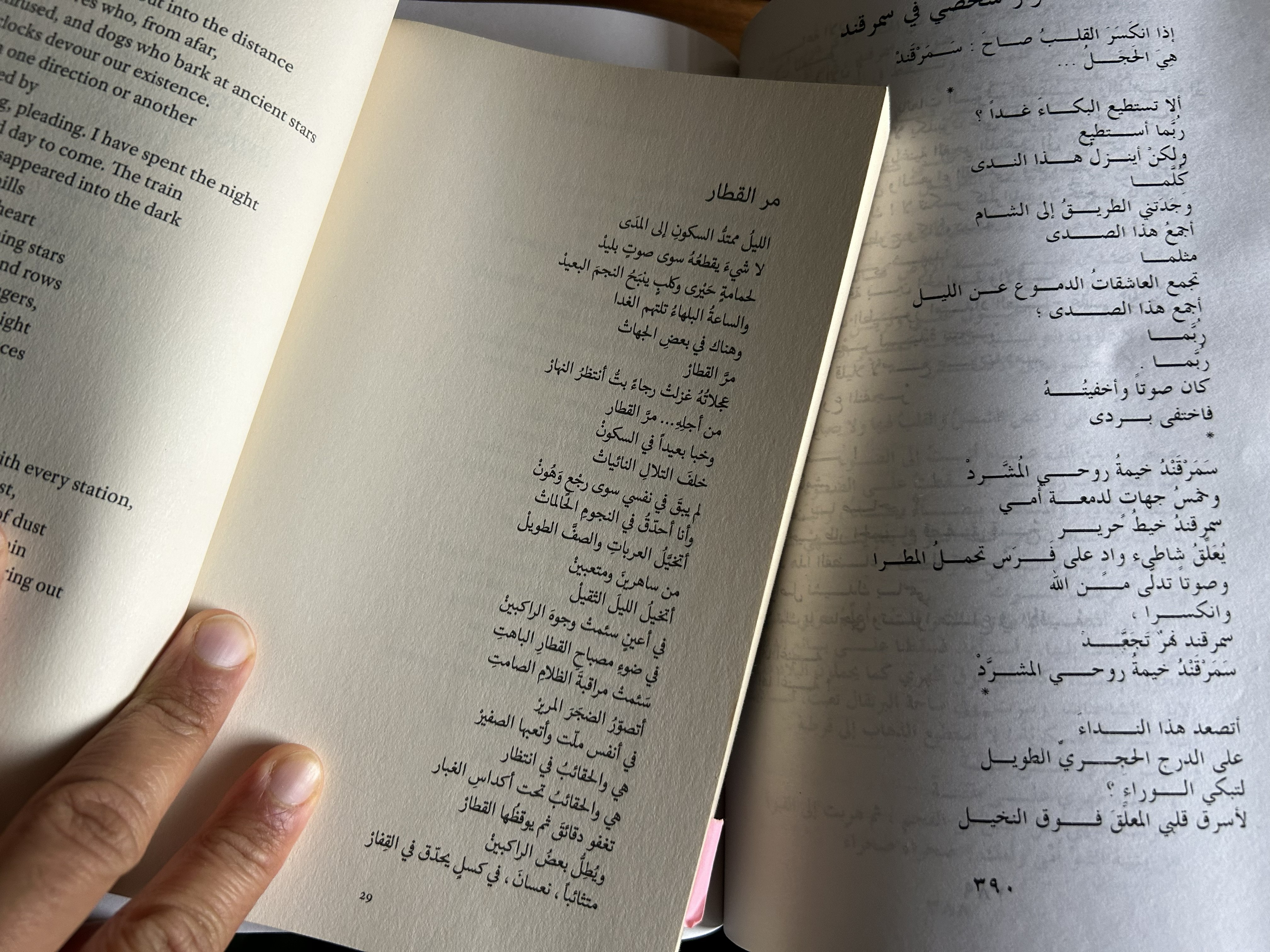
Image (top): an extract from The Desire of Life by Abu’l Qassim Al-Shabbi ارادة الحياة
Course Overview
All classes will be held live through Zoom, accessed via the Teachable platform. Times listed are UK time. Classes will be held live and will be recorded and shared with sign ups each week in case they miss the class.
Week 1: Introduction to Poetic Sound
Week 2: From Oral to Written: Poetry’s Evolution
Week 3: The Pre-Islamic Qasidah
Week 4: Arab Romanticism in the Age of Colonialism
Week 5: Modern Rivalry: Free Verse and Prose Poetry
Week 6: Mastering Our Skills
Each 2-hour lesson includes a lecture and live practice time. Participants will be provided with a task sheet and a poem to read in between each session to further support their learning, and resources to take their learning further.
Past student feedback
“The instructor has a wonderful, calm, and welcoming tone that immediately puts beginners at ease. His engaging approach left us wanting more time with the material.”
“Practicing meter and pronunciation is not something that had even crossed my mind before! It was very empowering to try, fail, and feel things click.”
“It has given me anchors, starting points, an idea about meters in arabic (I knew zilch before), helpful resources to keep going.”
“Auditory immersion made an intimidating subject approachable.”
“Ali is an excellent teacher and this is a rare opportunity”
Meet Your Tutor
Ali Al-Jamri is a Bahraini British poet, translator and teacher. He is one of Manchester's inaugural Multilingual City Poets (2022-2025). His poems, translations and essays have been published in journals and websites including ArabLit, Modern Poetry in Translation and The Markaz. He has co-authored teacher texts with HarperCollins and is the editor of Between Two Islands: Poetry by Bahrainis in Britain (No Disclaimers, 2021) and ArabLit Quarterly: FOLK (ArabLit, 2021). His Arts Council England-funded short film, The Legend of the Looms (2025), is a ghost story celebrating dialect poetry and folk culture of Lancashire and Bahrain. When not writing or translating, he is an English teacher.

FAQs
How much Arabic do I need to do this course?
This course is for intermediate learners of Modern Standard Arabic or Classical Arabic or higher.
We would expect you to be familiar with the following:
- The small vowels and how to read them (damma, fatha and kasra). As well, all common diacritics and how to read them, including the sukun, shaddah and hamzat al-wasl (link)
- The three cases and case-endings (nominative/marfu’, accusative/mansub, genitive/majrur) (link)
- Sun letters and moon letters (link)
Rhythm and Rhyme is not a grammar course, though where needed we will explain grammar. However, the above knowledge is a necessary foundation for reading fluency. You will not be asked to write in Arabic.
All the poems we will read come with an English translation. We will only occasionally use transliteration.
What do you mean by a ‘sound first’ approach?
As this is best described with sound, watch this short video for an explanation.
How will this course help improve my Arabic?
Arabic has many sound patterns which meaning is drawn from. For example, you may already be familiar with verb forms, and how these patterned forms change the meaning of root words in predictable ways.
By focusing on the sound and musicality of Arabic poetry, we will build our understanding of sound patterns which can be mapped onto new vocabulary, grammar and contexts.
By understanding the context of 4 key literary periods, participants will be able to identify and understand references to these contexts in wider literature and art.
The course provides a toolset that makes Arabic poetry accessible, expanding the scope of participants’ learning and reading.
How do I know if my reading is strong enough to participate?
Participants are not expected to be confident readers, but should be able to decode a sentence, or a line of poetry, with all diacritics provided.
A simple test is to read the following lines of poetry by Abu Al-Qasim Al-Shabbi, which is in the resources for the course.
Set a timer: how much of the poem can you read within 3 minutes?
You should be able to read most, if not all, of the poem in that time.
How many words do you understand of the poem?
You should be able to recognise at least 50% of the words, and it is fine if your comprehension is incomplete.
وَقَالَتْ لِيَ الأَرضُ لَمَّا سَأَلْتُ: … أَيَا أُمُّ هَلْ تَكْرَهِيْنَ الْبَشَر؟
أُبَارِكُ فِي النَّاسِ أَهْلَ الطُّمُوْحِ … وَمَنْ يَسْتَلِذُّ رَكُوْبَ الْخَطَر
وَأَلْعَنُ مَنْ لَا يُمَاشِي الزَّمَانَ، … ويَقْنَعُ بِالْعَيْشِ عَيْشِ الحَجَر
After you’ve tried it, you can compare yourself against this audio recording of the same poem.
If the above was a challenge, that’s not an issue! You’ll learn and grow through the course. However, if you feel the challenge was too great, then you may wish to do the course in the future when your reading has improved.