When the Sky Spoke Arabic:
Science, Culture and the Lost Story of a Golden Age
Online | Mondays | 6-8pm
11, 18, 25 January 2027 | 1, 8, 15 February 2027
This course invites you on a journey through one of the most vibrant and overlooked periods in human history: the scientific and cultural flourishing of the Arab and wider Islamic world. At a time often described in Europe as the “Dark Ages,” cities like Baghdad, Cairo, Samarkand, and Cordoba were alive with curiosity, experimentation, art, and intellectual exchange.
Across six immersive sessions, we will explore how scholars, travellers, poets, engineers, philosophers, and physicians transformed the way we understand the universe, from mapping the stars and inventing algebra to building hospitals, automata, and cities powered by water and ideas. But this is not just a history course. It is a story about people, environments, and the movement of knowledge across cultures.
Each session combines storytelling, visuals, and hands-on activities. Participants will build simple scientific tools such as a star chart or camera obscura, explore manuscripts and historical artefacts, and connect past discoveries to modern science and technology.
Along the way, we will ask deeper questions: Who gets remembered in the history of science? What does it mean to “invent”? And how can reclaiming these stories reshape how we think about knowledge today?
The course concludes by reflecting on the legacy of this era, why it faded, how its ideas travelled into the Renaissance, and what it means for us to carry this shared human heritage forward.
Who is this course for?
This course is designed for adult learners with an interest in history, culture, and science. It is particularly suited to those curious about the global history of knowledge, cross-cultural exchange, and the often-overlooked contributions of the Arab and Islamic world. The course is accessible to a general audience, and no prior knowledge or specific background is required.
Images
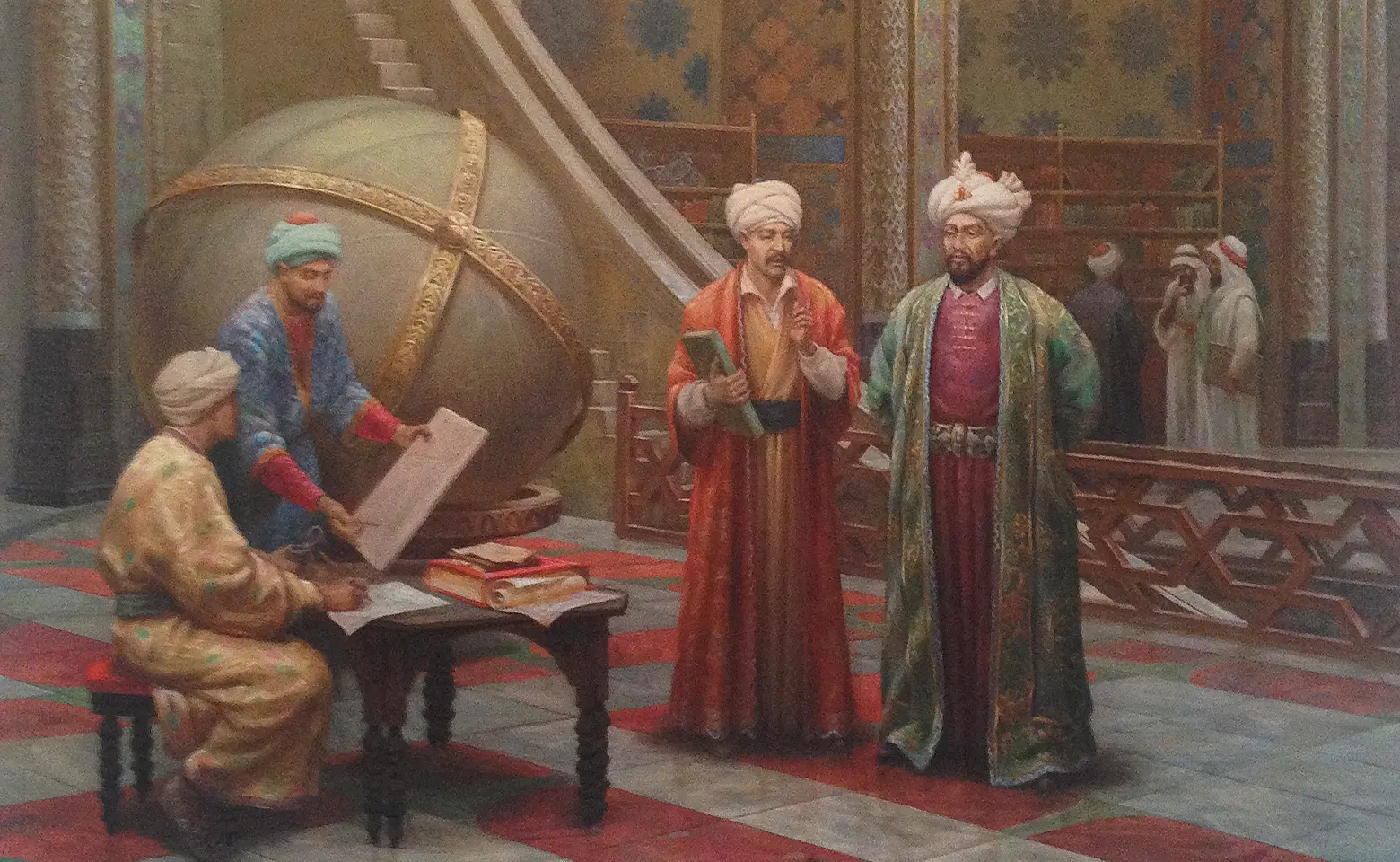
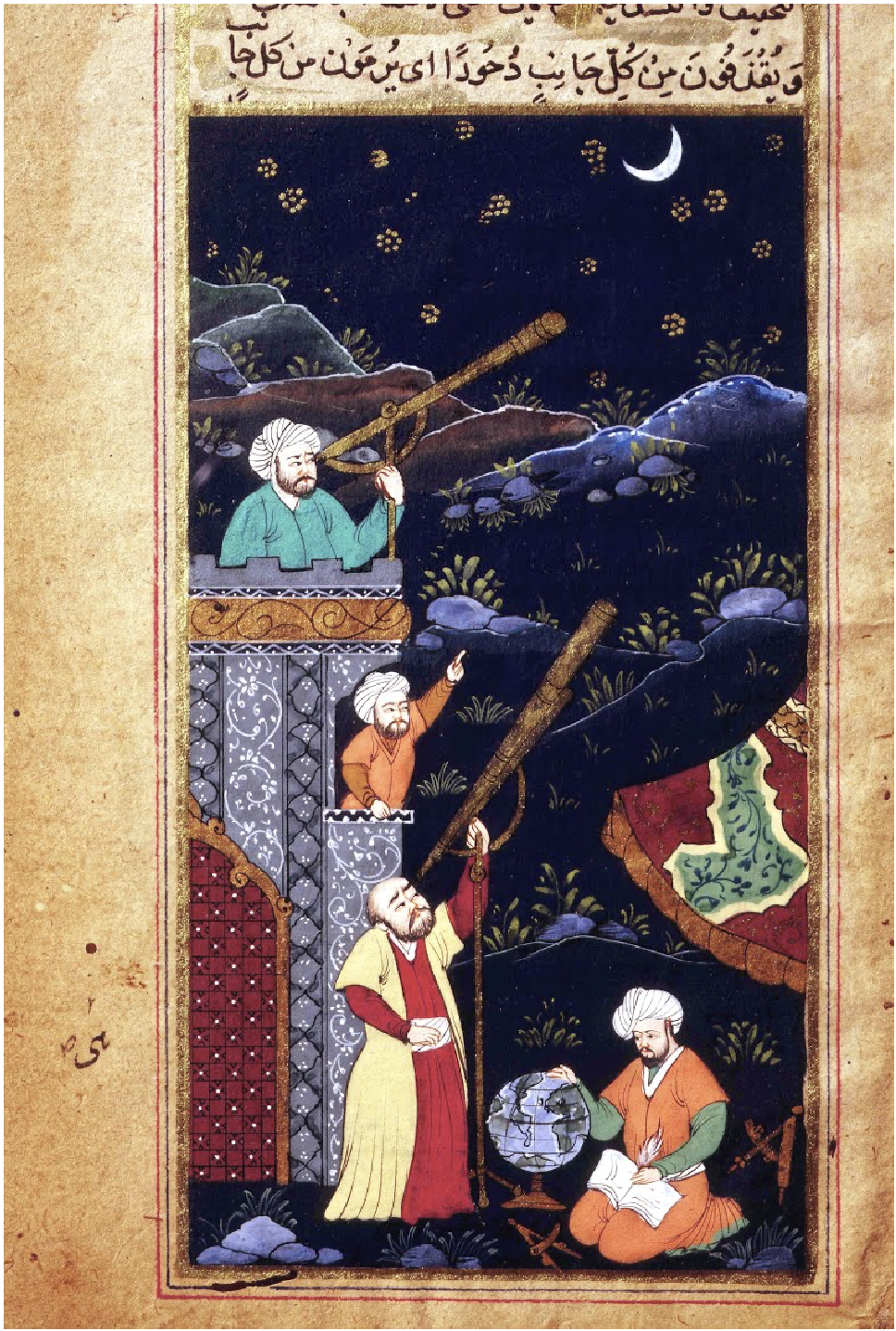
Top: Ulugh Beg with Ali Qushji in an observatory in Samarkand
Below: Elephant Clock manuscript by Al-Jazari from The Book of Knowledge of Ingenious Mechanical Devices
Course Overview
All classes will be held live through Zoom, accessed via the Teachable platform. Times listed are UK time. Classes will be held live and will be recorded and shared with sign ups each week in case they miss the class.
Monday 11 January 6-8pm
Session 1: When the Sky Spoke Arabic: Rethinking the Story of Knowledge
What if the stars themselves could tell a different history?
We begin by challenging the familiar narrative of the “Dark Ages” and rediscovering a world in which knowledge travelled across deserts, seas, and continents. From camel caravans to cosmic curiosity, this opening session sets the stage through the landscapes, trade routes, and exchanges that shaped intellectual life in the Arab world.
Monday 18 January 6-8pm
Session 2: The Library of the World: Baghdad, Books, and the Birth of Ideas
Imagine a place where the knowledge of the entire world was being translated, debated, and expanded.
Step inside the House of Wisdom and meet the translators, thinkers, and patrons who built one of history’s greatest intellectual movements. Discover how Greek, Persian, and Indian knowledge was transformed and why translation itself was revolutionary.
Monday 25 January 6-8pm
Session 3: The Making of Modern Science: Numbers, Light, and Proof
How do you turn curiosity into certainty?
This session dives into the birth of algebra, algorithms, and experimental science. From al-Khwarizmi’s mathematics to Ibn al-Haytham’s groundbreaking work on light and vision, we uncover how systematic inquiry and experimentation began to take shape.
Monday 1 February 6-8pm
Session 4: Healing Bodies, Mapping Worlds: Medicine, and Knowledge on the Move
What happens when knowledge travels?
Follow physicians, travellers, and polymaths across continents. From Ibn Sina’s medical canon to Ibn Battuta’s journeys, this session reveals how science, geography, and culture were deeply connected and how hospitals became centres of learning.
Monday 8 February 6-8pm
Session 5: Machines, Music, and Meaning: Engineering Life and Culture
Science isn’t only in books, it lives in cities, sounds, and everyday life.
Discover water clocks, automata, architecture, poetry, and music. Meet inventors like Al-Jazari and explore how engineering, art, and culture were intertwined. From gardens to mechanical devices, this session reveals a world where creativity and science were inseparable.
Monday 15 February 6-8pm
Session 6: The Rise and Fall of Ideas: What Remains and What We Carry Forward
Do golden ages really end or do they transform?
We close with a powerful reflection on legacy. From the Mongol sack of Baghdad to Ibn Khaldun’s theory of civilisation, we examine why this era declined and how its ideas travelled into the Renaissance and beyond.
This final session invites participants to rethink science as a shared human story and to consider their own role in shaping its future.
Meet Your Tutor
Mohamed Daoud is an award-winning science communicator with over 14 years of experience in public engagement. He holds a Master’s degree in Science Communication and Public Engagement from the University of Manchester, where he developed a particular interest in the history of science, medicine, and technology, and in the ways these histories have travelled across cultures and centuries.
With a background in geophysics and astrophysics, Mohamed works at the meeting point of science, storytelling, and cultural history. As Scientific Advisor and Head of Content at the 1001 Inventions Foundation, he led the development of international exhibitions, festivals, films, and educational programmes illuminating the scientific and cultural achievements of the Arab and Islamic world. His work has taken him across the Middle East, China, Central Asia, Russia, Europe, and beyond, engaging audiences with the rich yet too often overlooked legacies of this era.
His commitment to inclusive science communication has been recognised internationally, including the Study UK Alumni Social Action Award and Falling Walls Engage for widening access to science education in underserved communities.
He is passionate about recovering overlooked histories and presenting science as a shared human story shaped by exchange, creativity, and connections across cultures and time.